
Riding the Reunification Express
Romantic? No. Worth it? Yeah.
- Home
- Destinations
- Việt Nam
- Riding the Reunification Express
Riding the Reunification Express
Vietnam's overnight train is not the romantic rail journey people sometimes imagine, but it is absolutely worth doing at least once. I took two VIP 2-berth private sleeper cabins: Hồ Chí Minh City to Đà Nẵng, then Đồng Hới to Hà Nội. Both were on time, scenic, imperfect, and very Vietnam.
At a Glance

Yes, with caveats. It is absolutely worth doing at least once, especially for the scenery and the sense of travelling through the country rather than over it. Comfort depends heavily on cabin class.
If you can afford it, book the VIP 2-berth. It is a private, lockable cabin with two single beds and nobody else sharing your space. It is not a hotel room, but privacy makes a huge difference overnight.
For actually sleeping, I think the right sleeper bus has the edge. For views, space and the feeling of travel as an event, the train wins. They are different experiences, and both are worth doing.
Book directly through the official Vietnam Railways website at dsvn.vn. The site auto-translates to English, and your ticket will arrive in Vietnamese. Google Translate is enough to confirm the important details.
Yes. The train does not stop at Hội An. The nearest station is Đà Nẵng, and from there a Grab to Hội An takes around 30-45 minutes.
Yes, but plan ahead. Vendors sell snacks, beer, boiled corn, hard-boiled eggs and hot meals, usually chicken and rice. Vegetarian options are limited and vegan options are effectively snack-based.
No. Mobile reception through the Vietnamese countryside is patchy at best. Download music, podcasts, movies or offline work before you board.
I am not entirely sure where the whole romance of the rails thing came from, but with my budget I am yet to discover a romantic train journey.
If you are looking for it in Vietnam, you probably are not going to find it. But you will find something else entirely, and what you find is largely dependent on how much you pay.
During my first trip to Vietnam I took the overnight train twice: first from Hồ Chí Minh City to Đà Nẵng to reach Hội An, and later from Đồng Hới to Hà Nội. Both times I was booked in a VIP 2-berth private sleeper cabin with my fiance Chris. Here is what it is actually like.
Considering a sleeper bus instead?
Read my honest review of travelling by sleeper bus in Vietnam here: Vietnam sleeper bus review.
Understanding the Reunification Express
The railway line running the length of Vietnam from Hồ Chí Minh City to Hà Nội is informally known as the Reunification Express. The line was built under French colonial rule, severed during the war, and rejoined in 1976, a year after reunification. It remains one of the great overland journeys in Southeast Asia, not because it is luxurious, but because the scenery can be extraordinary.
Several trains run the full route daily, taking roughly 30 to 41 hours end to end. Most travellers break the journey across multiple legs, stopping in Đà Nẵng, Huế, Đồng Hới or other cities along the way. Ticket classes range from hard seat through soft seat, 6-berth hard sleeper, 4-berth soft sleeper, and VIP 2-berth private cabin.


The Cabin — What to Expect
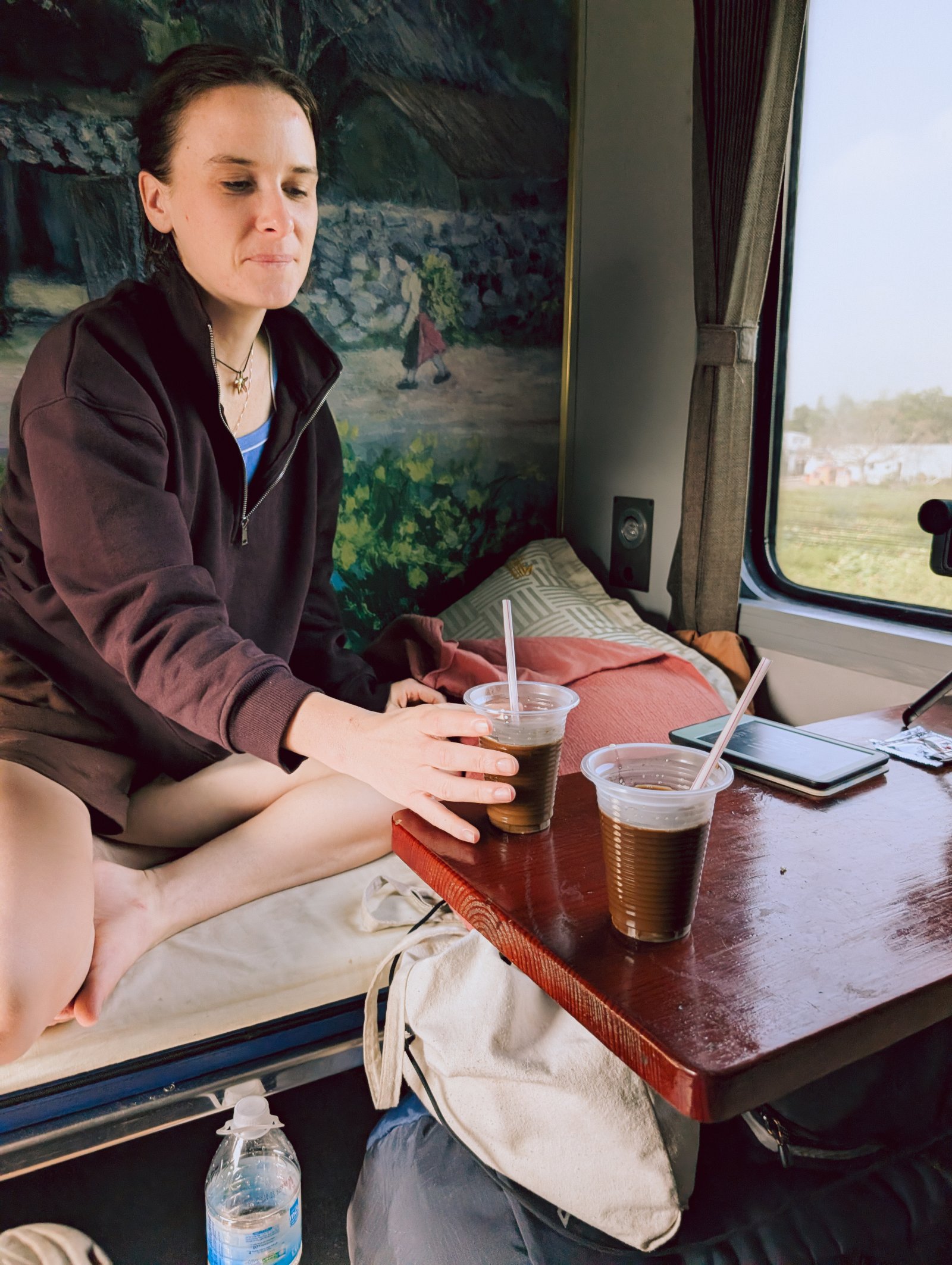
The VIP 2-berth cabin is the premium option on Vietnamese trains, and it is worth understanding what that means before you arrive expecting the Orient Express. The cabin is a private, fully enclosed room with a lockable door. Two single beds run parallel along either wall, with a small table by the window at the foot of the beds.
It is compact, but with just two people it is perfectly spacious. We were able to store all our luggage under the table without difficulty. Sharing the same train carriage in a 4 or 6-berth cabin is where things would get much cosier, much louder, and much less private.

Ticket class guide
Bedding, Bathrooms and the Blanket Situation
Each bed comes with a pillow, sheets and a blanket. Reading lights and power points sit at the end of each bed, and the air conditioning runs constantly. It fluctuates between cold enough to need socks and a jumper, and warm enough to start peeling those layers off again.
One thing worth noting: the bedding appears to be used continuously across the full route. As we pulled into Đà Nẵng, a train attendant came into our cabin, collected our pillows and blankets, refolded them with calm efficiency, and placed them neatly at the foot of the beds ready for the next passengers. A sleeping bag liner and your own pillowcase are excellent ideas.

Shared toilets are located between carriages. They are functional, occasionally pungent, and honestly pretty good by Southeast Asia transport standards. There are also basins between carriages where you can wash your face and brush your teeth.
What to pack
Booking — Use the Official Site
Both journeys I took were booked directly through dsvn.vn, the official Vietnam Railways website. The site auto-translates to English and the booking process is straightforward. Your ticket is issued in Vietnamese, which sounds more daunting than it is; a quick pass through Google Translate is enough to confirm your route, cabin, date and names.
The experience felt more secure and reliable than using third-party booking platforms like Klook or 12Go Asia. Those can be useful for comparing options, but for a direct rail ticket, book directly where you can.


Route 1: Hồ Chí Minh City to Đà Nẵng
Route 1 at a glance
The train departed from Ga Sài Gòn in the mid afternoon. The station is large and well organised, with convenience stores and cafe-style eateries where you can grab hot food before boarding. Boarding was calm because every passenger has a specific seat or cabin. There is no scramble for the good berths.
Always assume the train will depart on time. Vietnamese trains ran with surprising efficiency on both of my journeys, so be in the station waiting room at least 30 minutes before departure. This train arrived into Đà Nẵng on time, to the minute.

Getting to Hội An from Đà Nẵng
The train does not go to Hội An. From Đà Nẵng station, a Grab to Hội An is straightforward, especially around 9am when there are plenty of drivers available. The ride takes around 30-45 minutes and costs approximately AUD $30 at the time of writing.
Porters at the station may offer to arrange a taxi. That is fine if you prefer, but pricing can be higher than booking through the app yourself.
Route 2: Đồng Hới to Hà Nội
Route 2 at a glance
The second train was a different experience, not because the train itself was different, but because knowing what to expect made the whole thing much more relaxed. We boarded at Đồng Hới, the gateway station for Phong Nha, in the late afternoon after a 40 minute Grab ride.
For the first few hours, before darkness settled in, the views were beautiful: rice paddies, karst mountains, tunnels and that soft late-day light that makes even a slightly grubby train window feel cinematic. This route was easily the more scenic of the two.

Food — Plan Accordingly
The food situation on overnight trains in Vietnam is variable. It is manageable if you are a meat-eater and comfortable with train food. As a vegetarian with a healthy fear of questionable rice, I steered clear of the hot meals.
Vendors work the carriages selling chips, lollies, beer, boiled corn, hard-boiled eggs and hot meals, usually chicken and rice with vegetables and sauce. On our first journey, my dinner was a bag of chips, lollies and a Snickers. This is not a good dinner.
By the second journey, I had learned the obvious lesson and ordered a bánh mì through Grab before boarding at Đồng Hới. A bánh mì is close to ideal train food: filling, self-contained, room-temperature friendly and utensil-free. I would probably pack two next time.

Food hack
Order or buy a bánh mì before boarding. Cup noodles can work too, but hot water taps are not always easy to find or functioning. Bring a fork or chopsticks if noodles are your backup plan.
What to Bring
The things nobody tells you before your first overnight train in Vietnam are mostly small, practical and genuinely important: earplugs, noise-cancelling headphones, an eye mask, warm layers, socks, a sleeping bag liner, a small towel, accessible toiletries, food, and downloaded entertainment.
The trains are loud, the air conditioning is unpredictable, there is no WiFi, and mobile reception through rural Vietnam is patchy. If you are planning to work, make sure it is work you can do offline.


Honest Verdict
You should do it at least once. Not because it is the most comfortable way to travel Vietnam, because it certainly is not, but because it is one of the most Vietnam ways to travel Vietnam. The Reunification Express runs through the spine of a country with a complicated, layered and extraordinary history.
If you want a good experience, book the VIP 2-berth. It is not cheap by Vietnamese standards, but the difference between a private lockable cabin and a shared berth at midnight is enormous. If you want a more chaotic, sociable experience, book the 4-berth. You will probably have better stories and almost certainly have a worse night's sleep.
My preference for long-distance overland travel in Vietnam remains the sleeper bus, mainly because the right operator gives you a quieter and more genuinely restful journey. But the train has something the bus does not, and the views on the Đồng Hới to Hà Nội leg were worth the broken sleep on their own.
Price note
Prices were correct at the time of writing. Always check current fares at dsvn.vn before booking, because routes, train numbers and cabin availability can change.
Book direct with Vietnam Railways
Use dsvn.vn for official Vietnam Railways tickets, then translate the Vietnamese ticket confirmation before travel so your route, date, cabin and names are clear.

Explore Some More

18 Places to Visit in Ho Chi Minh City
Everything we saw, experienced, and learned over two days exploring Ho Chi Minh City on foot, so you can plan a slightly less chaotic visit.

A Guide to Vietnamese Coffee
Vietnam is one of the world's great coffee nations, second only to Brazil in global production, and yet the way coffee is drunk here looks almost nothing like…

Bali to the Gilis and Lombok by Fast Boat: An Honest Guide
Indonesia’s fast boats have a reputation, and if you read enough stories before your first crossing you can scare yourself silly. I have taken seven crossings between Bali,…

Getting Clothes Tailored in Hội An
Treat Hội An tailoring as a paid experience rather than a shortcut to cheap clothes. The best _value_ is usually in the cloth market, but the best outcome…

Hội An's Full Moon Lantern Festival
The most beautiful night in Old Town: floating lanterns, packed riverbanks, market food, music, boats, and just enough chaos to make Hội An feel completely alive.

Riding the Reunification Express
Vietnam's overnight train is not the romantic rail journey people sometimes imagine, but it is absolutely worth doing at least once. I took two VIP 2-berth private sleeper…

Saigon Scooter Food Tour Review
A four-hour introduction to Ho Chi Minh City through street food, flower markets, local stories, and the unexpected joy of seeing Saigon traffic from the back of a…

The Duck Stop, Phong Nha: What It’s Actually Like to Become a Duck Leader
Everything you need to know before visiting The Duck Stop in Phộng Nha — what happens, how to get there, what it costs, and an honest take on…

Vietnam's Sleeper Buses - An Honest Review
Vietnam's sleeper buses have a grim online reputation, but the right operator changes everything. I took HK Buslines from Hội An to Phong Nha and found a private…