
South Cape Bay
The edge of the continent
South Cape Bay
A beautifully varied walk to the very end of the road, and the edge of the continent.
At a Glance

Most people take around 4 hours return, though this can vary depending on conditions, stops at the coast, and time spent exploring the beach.
This is a Grade 3 walk. The track is well-formed and mostly gentle, but the distance and exposure make it more demanding than it first appears.
Yes, for reasonably fit beginners who are comfortable walking longer distances. The track is not technical, but it is long.
Swimming is not recommended. The Southern Ocean is cold, powerful, and unpredictable, with strong currents and swell.
Late spring to early autumn offers the most stable conditions. Wind can be an issue year-round, so check forecasts carefully.
Yes. This walk forms the final section of the South Coast Track, a multi-day hike through Southwest National Park.
This is a walk that looks straightforward on paper but offers far more variety than you might expect. While the gradient is gentle and the track well-formed for most of the way, the length and exposure mean it’s still a full-day outing for many people.
This walk is ideal if:
Best Time to Do the South Cape Bay Walk
The South Cape Bay walk can be done year-round, but conditions play a big role in how enjoyable it feels.
Late spring through early autumn generally offers the most reliable weather, longer daylight hours, and slightly calmer conditions. That said, this is the far south of Tasmania, and wind can be an issue at any time of year.
If strong winds are forecast, expect the exposed sections across the buttongrass plains — and the bay itself — to feel much more intense and potentially more challenging.


What to Expect on the South Cape Bay Walk
This is a long but gently graded walk that offers a surprising amount of variety.
Expect:
Sheltered coastal forest and tea-tree scrub at the start
Open buttongrass plains crossed by narrow duckboard
Sections of dense coastal scrub with an enclosed feel
Sandy track near the coast
Clifftop views and a wide, exposed beach at South Cape Bay
While the walk is not technically difficult, it is long enough that fatigue can creep in, especially on the return. The interest comes from how the landscape shifts as you move south, rather than from constant big views.
Track Conditions and Things to Be Aware Of
Did you know?
Tasmania has only three snake species, with tiger snakes being the most likely to appear here. Lowland copperheads and white-lipped snakes are also possible. As always, give them space and keep an eye on where you place your feet.
The track to South Cape Bay is well-formed and clearly marked, but conditions vary along its length.
The forested sections are generally firm underfoot, while the buttongrass plains can feel exposed and windy. The duckboard is narrow in places and can be slippery when wet. Near the coast, sandy sections slow progress slightly.
Snakes are commonly seen along this walk in warmer months, particularly in the sheltered forest sections. Tiger snakes are the most likely ones you’ll encounter.
The short side track down to the beach is steep and rocky and should be approached with care, especially after rain. Tides and swell are also important to be aware of if you plan to spend time on the beach.
Where the South Cape Bay Walk Begins
The South Cape Bay walk begins at Cockle Creek, the end of Australia’s southernmost road — though interestingly, this walk will not take you to Australia’s most southern point, which was slightly disappointing, but still worth doing.
Given its location, you might expect this walk to be much more challenging. Instead, it starts in a very low-key manner and never really becomes overly difficult. It does traverse a surprisingly large number of different ecosystems and environments, though, which makes it feel a little longer than it actually is.
A Calm and Sheltered Start Through Coastal Forest
The first few kilometres follow a quaint boardwalk and a well-worn track through coastal woodland and tea-tree scrub. The gradient is mild, the track surface is firm, and the surrounding forest offers welcome shelter from wind and weather.
This is one of the most pleasant sections of the walk and also one of the best for wildlife spotting. Lyrebirds are frequently seen here, scratching through the leaf litter and darting across the track. Mainland Australians will know how hard lyrebirds are to spot in places like the Victorian highlands, but here in Tasmania they are much more abundant and — similar to most of the wildlife — far less afraid of humans. Snakes are also commonly encountered in this section, particularly in warmer months.


Crossing the Buttongrass Plains
Before long, the forest gives way to open buttongrass plains, and the character of the walk changes noticeably.
Here, the track crosses broad moorlands via narrow duckboard — skinny boardwalk sections just two planks wide. These raised paths are essential for protecting this slow-recovering environment and for keeping your boots at least partially dry.
This section is fully exposed and can be very windy, which is more often the case than not in this part of Tasmania. On calm days, it’s expansive and peaceful. On blustery days, it’s a reminder that you’re walking along the southern edge of the continent, with the Southern Ocean not far away.
The duckboard continues for some distance and requires a bit of attention, particularly in wet conditions. It’s not difficult, but it’s narrow enough to keep you focused.
As the Coast Draws Closer
As you approach the coastline, the walk shifts again.
The track becomes more undulating and enclosed by dense coastal scrub, at times forming a tunnel of vegetation around you.
Before long, the landscape changes again, with sand underfoot and ferns lining the track. Through breaks in the scrub, you’ll catch your first glimpses of South Cape Bay and the vast Southern Ocean beyond.
This transition is one of the highlights of the walk. The vegetation is so dense in places that it’s easy to forget just how close to the edge of the continent you are.

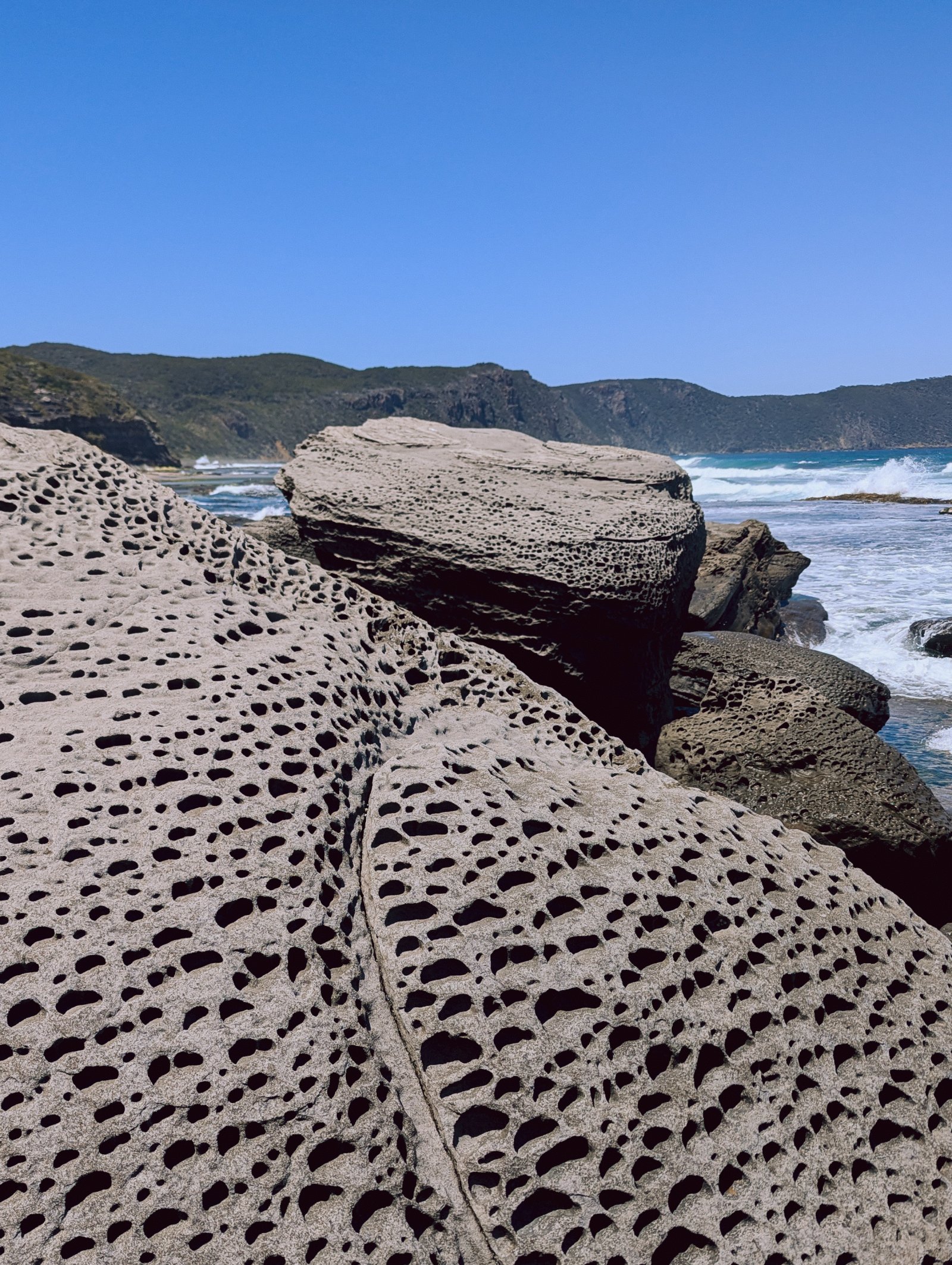
Standing Above the Southern Ocean
A short side track leads out onto a broad rocky platform perched above the sea cliffs, and the landscape looks and feels a little like standing on another planet.
From here, the Southern Ocean stretches uninterrupted to the horizon. There are a few rocky islands scattered offshore, but beyond that, there is nothing but water between you and Antarctica.
Down to the Beach at South Cape Bay
A narrow side track marked by cairns leads down to the beach via a steep, rock-cut staircase. It’s short but requires care, particularly if conditions are damp. If tides and conditions allow, you can wander along one of Australia’s southernmost beaches.
At certain times of year, the sand can be scattered with thousands of bluebottle jellyfish, washed ashore after strong winds and shifting currents. It was quite shocking to see at first — so many small blue bubbles littering the sand that they popped and crackled under our feet as we walked.
I would not recommend swimming here — jellyfish or not. Waves, undertow, and strong winds make this a dangerous place. However, it’s fantastic for beachcombing and exploring, so leave yourself plenty of time to wander.


Crossing Paths With Long-Distance Walkers
As you explore the bay, you’ll likely pass hikers emerging from tracks to the west. These are walkers completing the final day of the South Coast Track, a remote 6–8 day journey through Southwest National Park.
South Cape Bay marks the endpoint of that long wilderness route, which means day walkers briefly share the landscape with people who’ve been living out of their packs for a week or more.


Come on the walk with me
Click the image below to watch this walk on Instagram

Explore Some More

Bivouac Bay
I love a walk with plenty of variety, and this one made the kilometres feel like mere metres!

Duckhole Lake
An accessible adventure into Tasmania’s wild south, and a perfect introduction to its karst landscapes.

Lake Esperance
A walk through waratahs and a lush Tasmanian alpine landscape

South Cape Bay
A beautifully varied walk to the very end of the road, and the edge of the continent.

Hartz Peak
A short but impactful hike to the summit of Hartz Peak, showcasing a dazzling array of plant diversity!

Tahune Airwalk
A spectacular elevated walkway through the forest canopy, high above the rivers of Tasmania's wild southwest.

Fluted Cape
If you only have time for one short walk on Bruny Island, make it this one.

Labillardiere Peninsula
Pack plenty of snacks and your swimmers, and turn this hike into a full-day adventure

Waterfall Bay
Spectacular coastal views, dramatic rock formations, and some of the best wildlife spotting on the Tasman Peninsula, all within a casual clifftop stroll.

Cape Raoul
A challenging and exhilarating walk to one of Tasmania's most dramatic coastlines, and some of the best dolerite column formations on the planet.

Coal Mines Historic Site
Crumbling convict-era ruins, underground cells, and sweeping views of Norfolk Bay, all within a short and easy walk.

Cape Hauy
A stunning loop walk along one of Tasmania's most dramatic coastlines, with towering dolerite cliffs, endless ocean views, and some of the best whale spotting on the peninsula.