
Mount Rufus
Stellar summit views
- Home
- Destinations
- Australia
- Tasmania
- Mount Rufus
Mount Rufus
Summit views that will have you spinning around like a needle in a compass
At a Glance

This is a long, Grade 4 hike, which means it's quite challenging for the less experienced. The final ascent is the steepest section (if you are travelling anticlockwise). So while I would never want to discourage anyone from this walk, make sure you are prepared to go slow if you need to!
7 hours for the full circuit. Start early to give yourself plenty of time to go slowly.
Generally yes, though you might find the occasional section where old and new markers seem to disappear - there is a mossy forest that can get a little confusing, but just keep your head up and find the next marker before you move on.. Stay alert and keep an eye on the path - Use Gaia GPS or All Trails to guide you, but always remember to bring a paper map.
The final 100 metres now has a new wooden boardwalk being installed. It is steep, and will get the heart rate up, but even if you aren’t super fit, you’ll be okay if you just go slow.
We tackled it counter-clockwise, and I think this is best if you would prefer a longer but much gentler ascent. The descent was quick but hard on the knees, so chose what is best for you!
This is a challenging 19 km circuit that takes you through almost every type of environment Tasmania has to offer, from wet forests, buttongrass moorlands, alpine heathland, and peatlands, before finishing with a rocky scramble to the summit.
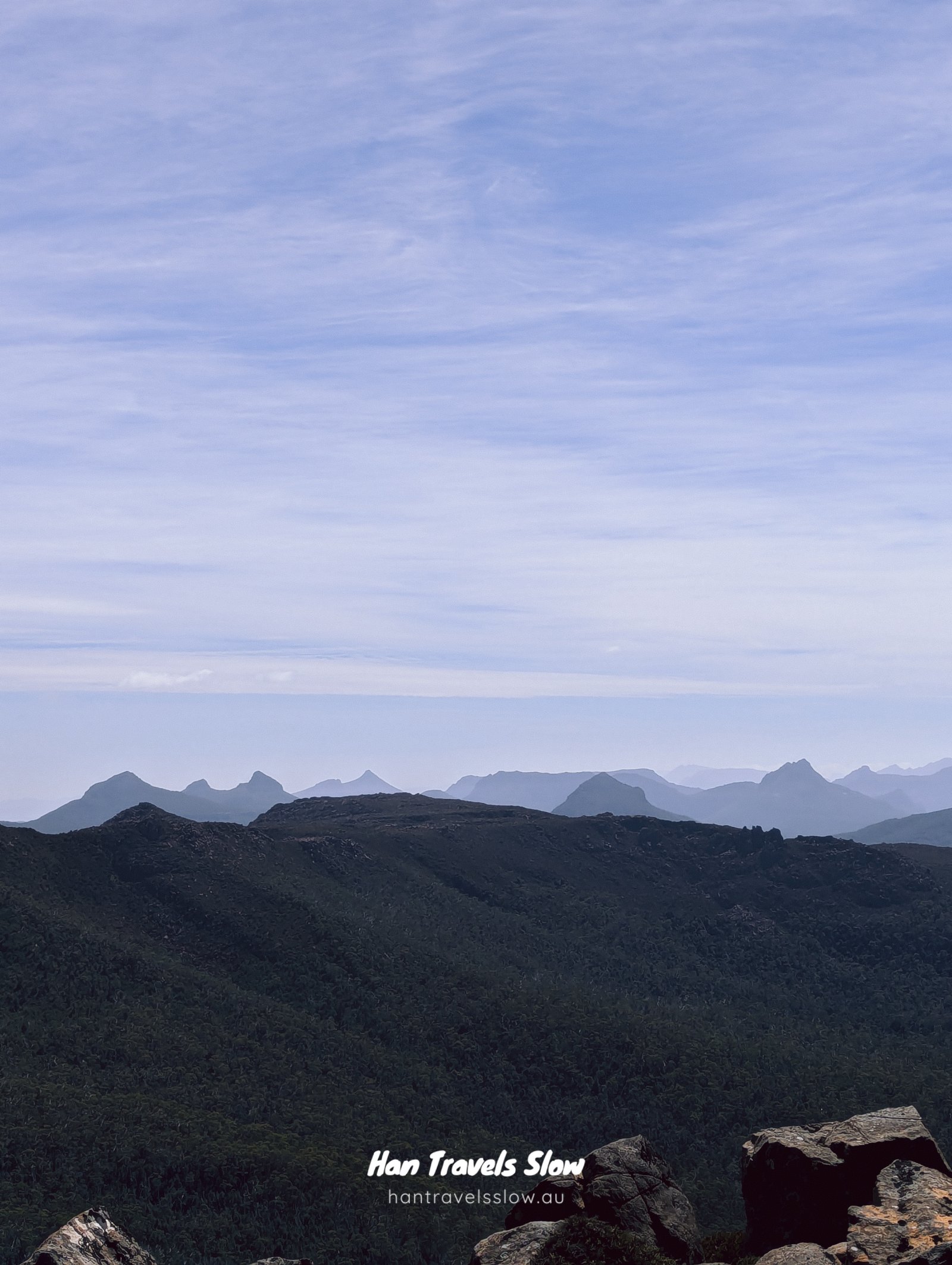
The views from the top stretch across countless mountain peaks, including King William II, Mount Ossa, Frenchman’s Peak, and Church Peak.
This walk is ideal if:
This walk takes you through an almost impossible variety of environments. You'll move between wet eucalypt forests dripping with beautiful stringy moss, open buttongrass moorlands dotted with crystal-clear tarns, alpine heathland, and peatlands. The transitions are sometimes so abrupt if feels a little like stepping through a vortex into another world.
Wet eucalypt forests with stringy moss and babbling streams
Buttongrass moorlands with views across open country
Alpine tarns reflecting the sky
Steep rocky ascents throughout
Tangled roots and boardwalks over wet sections
A final scramble up a rocky 20-metre section
Panoramic views across King William II, Mount Ossa, Church Peak, and Smiths Top


Best Time to Visit
Mount Rufus is best tackled in warmer months when conditions are drier.
Spring (September to November) brings warmer weather and the peatlands start to dry out a bit. The walk becomes much more accessible, though boots will still get wet.
Summer (December to February) is the best time to attempt this walk. The peatlands are at their driest, reducing the chance of sodden feet. Days are longer, giving you more light for a 7-hour hike. Clear, sunny skies mean the views from the top are even more beautiful!
Autumn (March to May) is still walkable if conditions have been dry, but the peatlands are getting wetter again. Expect mud and water. Days are shorter too, so you'll need to start early.
Winter (June to August) is not recommended, but also not impossible. The peatlands are waterlogged, days are short, and conditions can change on a dime - snow is possible and you need to be prepared for it. Unless you're an experienced, leave this walk for warmer months.


Track Conditions and Things to Be Aware Of
The track is generally well-marked, though you might find sections where markers seem to vanish. Stay alert and keep an eye on the path ahead.
Waterproof boots are recommended if you are to avoid wet feet. The peatlands and sphagnum moors are almost always mushy, unless you're hiking in peak summer. Even then, expect moisture. The boardwalks help in the wettest sections, but they can be slippery.
The tangled roots throughout the walk are ready to catch your boots, so watch where you're stepping, especially if you're tired toward the end of the day.


Walking Mount Rufus
The circuit begins in forest and gradually opens out as you gain elevation. You'll move through different ecosystems as you climb, and the variety makes the 19 km go quite quickly.
The peatlands keep things wet underfoot for much of the walk. The boardwalks help with the worst sections. The track is generally well-marked, though you might find the occasional section where old and new markers seem to vanish. Stay alert.
As you climb, the views expand. The great peaks of Tasmania reveal themselves: King William II, Mount Ossa, Church Peak, and Smiths Top.
The final ascent is steep and rocky. A new wooden boardwalk is being installed for the last 100 metres, but the final 20 metres remains a scramble up a rocky section. It demands sure footing, but the summit view is worth it.

Ponder While You Wander
Keep an eye on the vegetation as you climb. You'll move through distinct ecosystem zones, and each one tells you something about elevation and moisture:
Wet eucalypt forests (lower elevations) – Look for stringy moss hanging from trees and streams running alongside the track. These forests need moisture and shelter.
Buttongrass moorlands (mid-elevation) – Once you're out in the open, the landscape flattens and opens up. Buttongrass (actually a sedge, not grass) dominates. You'll see small tarns dotted across the moorland—these shallow pools are remnants of glacial activity.
Alpine heathland and peatlands (higher elevations) – The vegetation gets smaller and tougher. Sphagnum moss forms thick, spongy mats that hold water like a sponge. This is why your feet get wet—the peatlands are essentially bog.
Alpine sedgeland (near summit) – As you approach the top, vegetation becomes sparse and low-growing. The exposed rocky sections show you're nearing the summit.


Come on the walk with me
Click the image below to watch this walk on YouTube

Explore Some More

Bivouac Bay
I love a walk with plenty of variety, and this one made the kilometres feel like mere metres!

Duckhole Lake
An accessible adventure into Tasmania’s wild south, and a perfect introduction to its karst landscapes.

Lake Esperance
A walk through waratahs and a lush Tasmanian alpine landscape

South Cape Bay
A beautifully varied walk to the very end of the road, and the edge of the continent.

Hartz Peak
A short but impactful hike to the summit of Hartz Peak, showcasing a dazzling array of plant diversity!

Tahune Airwalk
A spectacular elevated walkway through the forest canopy, high above the rivers of Tasmania's wild southwest.

Fluted Cape
If you only have time for one short walk on Bruny Island, make it this one.

Labillardiere Peninsula
Pack plenty of snacks and your swimmers, and turn this hike into a full-day adventure

Waterfall Bay
Spectacular coastal views, dramatic rock formations, and some of the best wildlife spotting on the Tasman Peninsula, all within a casual clifftop stroll.

Cape Raoul
A challenging and exhilarating walk to one of Tasmania's most dramatic coastlines, and some of the best dolerite column formations on the planet.

Coal Mines Historic Site
Crumbling convict-era ruins, underground cells, and sweeping views of Norfolk Bay, all within a short and easy walk.

Cape Hauy
A stunning loop walk along one of Tasmania's most dramatic coastlines, with towering dolerite cliffs, endless ocean views, and some of the best whale spotting on the peninsula.